
Dohertys don’t do sick
Wally Walnut
“It was like an alarm went off in my head.”
-Gump Groupie
hard (härd) noun: difficult to bear or endure.
In February 2016, I only got one bike ride. It was on the 22nd. From what I could see, the photographs on my computer told me it was a very uneventful and rather boring one. By the end of February 2017, I got in three rides and would get in more with temperatures climbing into the 60s and 70s that week thanks to climate change. I was in week three of training for a 50-plus miles cancer fundraiser I would be riding in June of the same year. Having mostly trained all winter on the stationary bike at the local gym, any warm weather was more than welcome. Riding to my go-to place, I got some nice colors over the Cooper River and tiny signs of spring starting to pop up, little red buds on the trees and tiny purple crocuses pushing their way through the dead leaves left over from autumn.
On a break, I decided to climb the very steep and crooked ladder of a crew lookout to get a better view of the river while taking a break. Lacking any safety railing, I found my legs shaking spastically in an effort to stand erect. I managed to calm my body long enough to get two shots, one resulting in a blurry mass and the other coming out perfect. When I started to descend my lofty perch, a wave of intense fear came over me. Looking down the 20-foot drop at the ladder secured to the foundation by an old rusty padlock and chain, I panicked, “What if I fall?! What if I can’t get down?! Should I ask someone to help me? How embarrassing is this?!” I imagined the sun slowly fading, the temperature dropping to its more seasonal resting place. I pictured myself stuck on this platform, spending the night all alone in Camden, New Jersey. Yikes! Thankfully, however, I managed to climb down, calmly telling myself to take my time and carefully descend each rung no matter how long it took me. And then I thought, as I looked down at the padlocked chain, “Are there that many ladder thieves out there that they had to lock this ladder to the platform?!” It’s Camden, of course there are. This is how my brain works.
As a child, I climbed all kinds of heights: tree branches, tree houses, fire towers, lighthouses with no fear of falling. Back then there was “no danger.” No bubble wrap for us! We did things parents wouldn’t even think of their children doing today.
When we were little, Regina and I slept in bunk beds. Being older (by a mere 15 months, mind you), she claimed her stake in the top bunk. I remember being upset that she had this right simply because she was older, so I would poke her butt with my fingers through the mattress to let her know how unhappy this situation made me. After moving to Ramsey from Deer Park our bedroom was big enough that we could lose the bunk of our beds and sleep separately. So what to do with that bunk bed ladder?
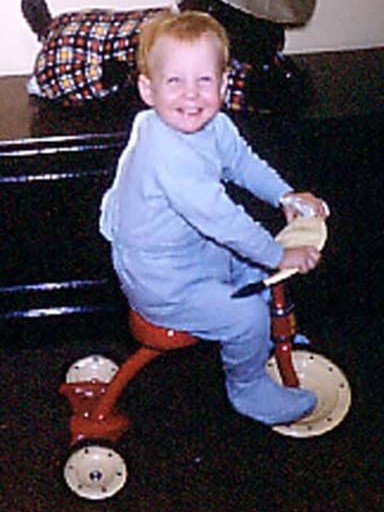
Our house at that time had a full semi-finished basement with the concrete blocks of the foundation still showing and a flat concrete floor. The house had been built in 1929 and sold to us by its original owner, who was then retired with grown children and downsizing as is expected of American seniors. Memories of the former family were sprinkled throughout the basement in the form of stickers pasted on the walls. We loved playing in that basement. My favorite activity was riding my tricycle in circles repeatedly around the staircase rising from the middle of the room. Now, back to that bunk bed ladder.
In our house, the washer and dryer were in the kitchen. To save on utility bills, on warmer days my mother would hang the laundry on the clothesline outside to dry, but if the weather wasn’t cooperative, she had my father erect a clothesline down in the basement, tied from one support pole to another. Regina and I had the brilliant idea of hanging that bunk bed ladder on the clothesline and using it like a swing. Sitting on a lower wrung, I would sway to and fro, legs kicking out straight as I pulled forward, arms pushing my upper body to the rear, then bending my legs and pulling my torso forward on the way back. We did this regularly, never thinking of the potential danger it created. I don’t even think our parents had any clue as to what we were doing either.
When I was five-years-old, at some point swinging on that ladder, I fell head first onto the concrete floor. I’m not exactly sure what happened; either the ladder slipped off the line or I slipped off the ladder. Neither here nor there, it knocked me out cold. The next thing I remember was waking up in my bed crying over the massive pain within my head, not knowing how I had gotten from the basement to my bedroom. Kathy quickly came to my aide and had me drink a glass of orange juice after speaking to our pediatrician. I don’t remember much after that and simply woke up in the morning and went to school. Knowing what I know now, I obviously had a concussion, and a bad one at that. However, strangely enough, it never stopped me from climbing or risking bodily harm until I climbed that crew tower. Now I try to move a little slower and am learning to take my time; slow and steady as Kathy would say. I like being alive too much.
I may have broken my head, but I’m proud to say that I managed to make it almost 40 years before breaking an actual bone. It was my right big toe after dropping a cast iron pan on it. Yes, it hurts like a son-of-a-bitch, and no, there’s nothing you can do about it but not walk on it or use crutches, both of which I’m not very good at (I’m a notorious ADHD klutz). I wasn’t exactly an adventurous kid, at least not physically, so beyond the occasional skinned knee after falling on the concrete playground at school or spraining a thumb while attempting to stop the humongous dodgeball the size of a planet from breaking my face, all my bones remained intact until that nasty cast iron pan came into my life. The second and only other time I broke a bone was on September 25, 2016.
Walking back from a neighborhood friend’s house late at night after a wonderful Rosh Hashanah dinner, my right foot tripped on a lip of sidewalk barely an inch high a mere two houses from home. Before I knew what happened, I was falling fast and falling hard, the whole time thinking, “Don’t put out your hand, Alice! Don’t break your fall with your hand, Alice!” I’m not sure where I learned or read this, but I suddenly remembered that one should never use their outstretched hands to break a fall because you will inevitably end up with broken hands. In whatever attempt I made to tuck and roll and land on any other body part, my hand wasn’t listening to the “Little Voice” – you know, that voice of reason we all have deep inside the back of our brains? After the hubby and the kid picked my crumpled body up off the concrete and a couple of hours of sobbing from the pain (and embarrassment, remembering the time my mother tripped and fell on the sidewalk several blocks from our Ramsey house, managing to elude any broken bones but not elude her embarrassment), I managed to fall asleep, only to wake with a very swollen and bruised hand the next morning. So I did what any sensible Doherty would do: I sucked it up and went to synagogue. After all, it was Rosh Hashanah.
First came the ice pack. It helped numb the pain, but the swelling continued. That’s when the cabbage leaves started. No, that’s not a typo – it says cabbage leaves. Thanks to my Russian friend, who walked with me the half mile from synagogue to my house, then the mile to her own home and then the mile back to mine because I didn’t have any cabbage leaves (and was justifiably shamed for their absence: “You are Irish and Jewish. Why do you not have cabbage?! Russians always has cabbage!”). My hand was swiftly wrapped in cabbage leaves and shoved in a plastic quart-size baggie with holes cut out like a tipless mitten for my fingers to poke through, obviously a procedure neither new nor strange to my Russian friend. It actually helped to bring down the swelling. Thanks to the Russian cabbage leaves, by the second day the swelling was minimal but then came the pain again. After two days of sucking-it-up-denial and warnings from the hubby, the kid, my Russian pal and several other friends at synagogue, it took a doctor friend to convince me to go to the local urgent care immediately after Rosh Hashanah ended (Sidenote: He did not advise me to go on Rosh Hashanah because it was not a life-threatening injury and one I could tolerate for the time being. I know, I know, strange but true for a religious Jew).
Yup, it was a fracture, albeit a very small one: my fourth metacarpal. I next found myself at an orthopedic urgent care debating cast versus brace with the doctor and his assistant. Thinking I could talk my way out of a cast so that I could continue riding my bike (right, and how that was going to happen was obviously beyond my comprehension), I convinced the doctor to give me a brace with the understanding the fracture would take longer to heal. As he walked me back to the waiting room lobby, I mistakenly asked him about bike riding. I should’ve kept my mouth shut. I don’t know why my body parts (particularly my big fat mouth) never listen to the Little Voice. Absolutely no bike riding for at least four weeks?!
“Maybe suing your neighbor for not fixing the sidewalk will make you feel better,” said one friend, followed up by the acquaintance who told me not to bother after explaining in great detail the intricacies of Sidewalk Law (yup, that’s a thing). It didn’t help, even after my own rant about how the municipality should be responsible for fixing our sidewalks because they’re public domain anyway and who can afford to fix them?! Concrete is very expensive, ya know. Besides, I like my neighbors and they don’t have lots of cash either. I wouldn’t want something so minor to affect our relationship or their wallets.
So how upset was I? VERY! I had purposely created a blog to explain why I had annoyed all my social media friends with hundreds of photos of my bike rides. I was also on a very specific timeline. But then I started thinking about how lucky I was; that it was just a small fracture and my body could and would heal itself; that it wasn’t my dominant hand; that my injuries could’ve been far worse (I’ve fallen off my bike and destroyed a lot more than a metacarpal); that the hubby and the kid were there to pick me up off the ground; that I have friends who go above and beyond to show how much they care, friends with cabbage leaves and medical knowledge; that the hubby has a steady job with excellent health insurance to cover all those medical expenses.
I also came to realize that all of my writing was not necessarily about cycling and photographs anymore; it was about all the losses in my life and how I had coped with them. It appeared that biking and taking pictures of my adventures had been one way I had managed and still do. I shared these moments with others in hopes of helping those who are having a difficult time experiencing their own grief, to inspire, support and move forward in peace. So, for a few brief weeks, my Gump Ride turned into my Gump Walk.
A week after breaking my hand, the hubby and I took the kid to the second of a number of colleges on our post-secondary education circuit tour throughout the Mid-Atlantic states. The hubby and I had agreed that she couldn’t be more than a four-hour drive from home (later that year she made it known it was no longer her plan by moving to Israel after graduating high school). I couldn’t believe we had gotten that far. One minute I was weeping on a couch with the hubby begging for a child and the next we were helping her apply to college. When you’re a parent, life continues on relentlessly with every blink of the eye. Children are a constant reminder of time passing; that life is happening, the clock is ticking, time is moving forward, despite what you want and how you feel. You are getting older too. The kid had seven months until high school graduation and was ready to begin the next phase of her life’s journey (i.e. to get the hell out of her parents’ house ASAP).
The campus we visited that day was Drexel University, located in Philadelphia. The interesting thing about Drexel is that we were completely oblivious to its existence. I’ve driven through the neighborhood and walked its streets dozens of times for decades. It’s not like it’s a new university – it was founded in 1891. How could I not have noticed this place?! Then it hit me: because I wasn’t looking. Although I didn’t intend for the day to be part of my temporary situation, I decided that it would be the first of my post-injury Gump Walks. Of course, our drive to the campus was on the heels of Hurricane Matthew, meaning torrential downpours and high winds. The initial tour gave us more of the same: cold air, whipping winds and pouring rain, but by the end of the tour, on our way to lunch, my beautiful blue sky suddenly emerged. There’s so much more to see when you’re not behind or on wheels. Since taking up cycling, I hadn’t realized how much I missed walking, something I had done every day for decades until my newfound love came along.
A rather large statue stands at the corner of Market and 33rd Streets. You can’t miss it: Drexel’s 10-foot-tall, 14-foot-long 4,100-pound dragon mascot. So, how is it possible that in my lifetime I never noticed this beast sitting in broad daylight on a major intersection?! Because I wasn’t looking, again. His name is Mario the Magnificent and represents ferocity and combativeness. He’s the perfect totem for any college team; this big guy says it all: “I will ruthlessly, and without mercy, fight you to your own death, no questions asked.” At this point, it’s fight or flight. This is when we all have a little Harry Potter inside of us. When faced by the dragon, we want to fight back. We’re not looking for it, let alone expecting it. We don’t want to be ripped apart by savage teeth or burned alive by raging fires. We find ourselves dangling in thin air by mere threads, we lose our grasp, we lose our footing, we pray for that one thing (like a magic broom) that will get us out of this predicament, only to be met by occasional and often transient victories – this is cancer.
It is our natural instinct to survive, regardless of what we face. Our body parts are ripped from us and our bodies ravaged by toxic chemicals. We face death, losing consciousness and hope, praying for the one cure that will prolong our lives. We are graced with occasional and sometimes long-term remissions – this is cancer.
This cancer, this dragon, this beast is ruthless. It shows no mercy. It slithers from one being to the next, ripping off limbs and setting fire to souls. But we need to take this lesson from the beast: we will be fierce and we will be aggressive; we will hang on, stand tall and pray and pray and pray; we will embrace whatever victories we are granted. For us survivors, we’re not going down without a fight.
Despite the orthopedist advising me to give my hand one more week to heal, by week four Ole Bessie and I were back in the saddle again. Screw ‘em!
Four months later, I started training for that cancer fundraiser. On the first day of phase one, I only needed 30 minutes in the saddle – a very slow start to a very long haul ahead. I headed to my go-to place, but just to the tail end of the route that is up the street from my house. Although there is a paved path running parallel to the road, there is a dirt trail that follows the river as it meanders throughout the woods within Pennypacker Park. The dirt trail is more suitable for walking or running these days. Thanks to massive erosion, various obstacles have emerged for cyclists these days, requiring extra vigilance when riding. There’s unexpected twists and turns and sudden splits without warning. There’s mud and layers of fallen leaves that conceal jutting rocks and tree roots with the occasional fallen tree due to intense flooding. There are hills, albeit small ones, with piles of gravel at their base. There are bridges with erosion, causing inches of curb to navigate without flipping your bike. Some of the pathways end abruptly, only to be met with random concrete staircases (originally serving as retaining walls off the main roads and highways). But the most dangerous obstacle for me proved to be the jutting roots.
I used to ride those trails every day, each time becoming more and more foolhardy and increasing my speed. I had recently rediscovered a love of mountain biking, having ridden many a crazy trail throughout the Pennsylvania Poconos the previous eight summers. It all came to an end in August of 2012. In my swelling confidence, I felt myself flying down a small slope, over a bridge and breaking left at a fork in the road. Next thing I knew, Ole Bessie was shaking violently and I was going down. Her handlebars twisted to the left, spinning the front tire in a counterclockwise 360, causing my hands to slip off. Before I knew what was happening, I fell onto my left side and skidded across gravel and dirt over 10 feet, still on my bike in a riding position. A couple who had been eating their lunch at a nearby picnic table came running over, as did a mother with her young son who were fishing on the river. Having just started a new job requiring recent first aid training, I knew not to move. The pain was unbelievable, and I was convinced my leg was not only broken but that I would find my bones bursting free from my flesh. After several rounds of loud, repetitive f-bombs (and educating the young boy on the various nuances of saying the f-word), I quickly told my bystanders not to touch me until I felt I could get up. I’m not sure how long I laid there, but I didn’t dare move. Finally, after some time, I was capable of shoving Ole Bessie off of my body and pushing myself up to a seated position. Eventually, with the help of the couple, I was able to hobble to the picnic table. As I sat, I looked over to the “scene of the crime,” noting a raised lanky root running diagonally across my path. I’m pretty sure I hit that sucker at just the wrong angle and that was that. Poor Ole Bessie was a mangled mess.
Sitting for some time, the couple offered to call the hubby and drive me home (the mother had run off with her son in total disgust of my potty mouth). I thanked them for their kindness and called the hubby to meet me at the playground across the street. Once home, I discovered horrendous bruising down the entire left side of my body, from neck to ankle. To my pleasant surprise, there were no broken bones whatsoever – an absolute miracle. Thank goodness for my helmet. I knew that if I hadn’t been wearing a helmet that day, my face would have been shredded to pieces, not to speak of what would have happened to my already broken head.
So, for about a month, I couldn’t ride my bike at all and slowly started back up by the time autumn rolled around. However, I didn’t hit those trails again for at least a year. I would also later learn that the dryer the ground, the more dangerous it is – a very valuable lesson. That summer we didn’t have a lot of rain and the ground was very dry and dusty, no doubt adding to the inevitability of my fall that day. More and more I had been finding my way back, now riding them in an overly cautious manner like some little old lady pushing a loaded shopping cart across a busy parking lot. However, it also forced me onto the streets, where I discovered the love of road tripping and bike tours. Even more miraculous, Ole Bessie didn’t need much repair, but due to the inability to completely correct them, I can no longer ride with no handlebars. Sigh.
I’ve said it before and I’ll say it again, the people in my family don’t do sick. This is something I learned from my father (and it’s not necessarily a bad thing). I remember my father having a hernia operation two weeks before his father died. Despite the obvious discomfort, he went to his father’s funeral and then came home and mowed the lawn. Two weeks after giving birth to the kid after 36 hours of labor and three hours of pushing, I was mowing the lawn too. This mentality finds itself in every waking moment of my life. Looking back, most of my life has been fairly uneventful, however, coasting contentedly over tiny ripples in life’s ocean. But, damn, when those big moments happen, it’s like getting hit with a tsunami. Each time, I find myself tumbling in the waves, unable to catch a breath and waiting for the water to calm. Each time I remind myself, “Tie yourself to a tree dummy!” like they did in that movie that scared the shit out of you when you were a little girl; the one that you saw after being caught in the undertow off the coast of New Jersey at age six; the one that kept you from going into the ocean until your 30s, returning once again thanks to your daughter’s love of water.
Maybe it’s just our way of stalling Death. We’re fully aware of its presence, looming over every breath, watching and waiting to be given the go ahead. And while Death hovers, we sit and wonder when it’s going to happen, where we’ll be, what we’ll be doing and how we’ll die. Some will wonder why. I can’t say that I’m okay with it, but I know it’s going to happen – just not for a few more decades please.
This is also how I’ve dealt with the death of loved ones in my life. Yes, there is a process necessary after losing a loved one if you’re going to survive. But once followed, it’s time to move on. You are still alive. You must continue to live. Cycling has been a lifetime coping mechanism for me; no better way to live than using the strength of your own body to move through space, feeling your heartbeat in your chest as your lungs expand and contract to keep up while the wind passes through your soul. Besides, I’ve had a landscaper since 2004, so now I don’t have to mow the lawn anymore. I’ve got plenty more time on my hands these days.
When I was pregnant with the kid, the hubby and I planned the course of her life over the next nine months with precise judgment, Dr. Spock and What to Expect When You’re Expecting in tow. You see, my pregnancy was going to be “perfect” – there was no room for failure.
As a little girl, my plan was to have six children, just like the Brady Bunch, three girls and three boys, minus the death, divorce and optional indentured housekeeper. As an adult, having worked with some of the most damaged youth as the result of the most mucked up parents in existence, I swore off motherhood forever. The hubby wasn’t much keener on the idea either, thanks to family court pretty much zapping him of any desire to procreate. But then it happened – after seven years of marriage, me having transferred to an adult unit and the hubby becoming a managing attorney, we sat on the couch and admitted to one another through a waterfall of tears that we really wanted to have kids together…and discovered I couldn’t get pregnant.
There’s an old Yiddish saying: Der mentsh trakht un got lakht: Man plans and God laughs.
In 1995, after two years of multiple physicians telling me, “It’s just allergies, hun,” I was diagnosed with a rare neurological condition known as pseudotumor cerebri. Pseudotumor cerebri (PTC) literally means “false brain tumor” and is due to high pressure within the skull caused by the buildup of cerebrospinal fluid (CSF), causing severe headaches, neverending nausea and pulsating sounds like no other inside the head. Basically, your brain believes it has a tumor that doesn’t exist. And that buildup does quite a number on your head, creating headaches like you’ve never experienced ever in your life (and that includes migraines, of which I’ve had a number). Close your eyes and envision the inside of your body: your heart pumping blood, your lungs filling with oxygen, your kidneys filtering impurities, your bladder filling and releasing. Now imagine the fluid that runs up and down your spine into and out of your brain and it gets stuck inside your head; the head that contains your brain inside a skull made of inflexible bone. There’s only so many openings in the skull allowing fluid to escape or get trapped. Enter the sella turcica, that nice little hollow in the sphenoid bone nesting the pituitary gland.
Not only did my CSF push its way through my eye sockets and ear canals, causing temporary blindness, frightening vertigo and chronic tinnitus to this day, it decided to form a pool inside my sella and, in turn, drowned and pulverized my pituitary gland into a pancake, causing a condition known as hyperprolactinemia (abnormally elevated prolactin). Biology 101: a mammal needs a pituitary gland to reproduce, but my pituitary gland didn’t know that because it was a hot mess smashed against my sella floor and believed that I was perpetually pregnant.
Luckily for me, in 1997 the particular medication I needed in order to get pregnant had finished its trials and was available for use: cabergoline. It was the easiest medication I’ve ever taken in my life: half a pill once a week and no side effects whatsoever. Within two month’s time, I was miraculously pregnant with the kid. Eight years later, following a total hysterectomy, the obstetrician would tell me how baffled he was that I ever got pregnant in the first place. Numerous fibroids (one as big as a grapefruit) had grown like fungus on some old rusty pipes and severe endometriosis had left me hemorrhaging inside and outside of my upwardly tilting uterus that had fused with my bladder, both fusing to the back wall of my abdominal cavity (which would explain a very painful pregnancy and extremely difficult delivery, let alone decades of painful periods and urinary leakage). By that point, we all believed the kid truly was a miracle.
One of the greatest things about the kid is that she was sleeping through the night within the first five weeks of life and in her own bed. She unquestionably took after her father, who can fall asleep at the drop of a hat without warning. I, on the other hand, can only fall asleep at the drop of a hat without warning while watching a movie. Since day one, every night at bedtime the hubby would take the kid to her room, read a book to her and she would fall asleep mostly without incident. What the kid sucked at was napping, which completely ceased the day we took away her binky at 18 months-of-age. In the end, it was a godsend. She was definitely going to sleep through the night for sure. I can’t say I’ve ever been that good at going to sleep. And the kid takes after me when it comes to napping: it’s nonexistent.
When we were little girls, Regina and I, tucking ourselves into bed at night, waited patiently for our father to come upstairs to say goodnight and turn off the light. Begging him for a bedtime story, he would reluctantly fabricate some kind of tale to get us to go to sleep: “Once upon a time there were two girls named Regina and Alice and they went to bed. The end.” Other times he seemed to be telling a story, but inevitably the “story” was just a lengthy joke with punchlines we seldom understood – and sometimes he liked to play pranks.
One of the big fads back in the 1970s was baton twirling. On a regular basis the kids on my block would gather together (girls and boys alike) in someone’s driveway and practice various twirling routines. We even formed a “class” at one point, two older neighborhood sisters being our “teachers.” But the real rage of baton twirling at that time was the glow-in-the-dark baton: a two-foot long green plastic rod with rubber luminous-coated rubber balls shoved on the ends. Hours were spent in darkened rooms twirling away to watch the streaks of light strobing through the air.
Back to our nightly bedtime routine and that occasion when dad played a prank so worthy it sticks in my mind to this day over 55 years later. After telling whatever “story” of the night, my father turned off the light and pretended to leave the room, seemingly closing the door behind him. As Regina and I drifted off into la-la land, we heard the soft moanings of a ghost lost in purgatory. Sheepishly peeking from behind my covers to see the entity in the dark, all I could see were two small green eyes floating in the air and then, “BOOGETY, BOOGETY, BOOGETY!” those small green eyes jumping up and down in some kind of ritualistic dance performed prior to devouring its prey. Unbeknownst to us, dad had secretly grabbed the glow-in-the-dark baton before turning off the lights and stayed in the room long enough to convince us he was long gone downstairs. Not exactly my idea of a good bedtime story.
Now, after decades of fear-of-sleeping later, I can’t sleep. Between the hot flashes and mind-racing anxiety over the last dozen years, I pray for one solid night of rest, staring at the doorway, waiting for those two small green eyes floating in the air to come and devour me, my only saving grace that pseudotumor cerebri and hyperprolactinemia are no longer being major issues in my life. There’s too much else to worry about these days.
 My Gump Ride