
Boundary Creek
October 25
“Lieutenant Dan, ice cream!”
-Forrest Gump
boundary (ˈbau̇n-d(ə-)rē ) noun: something that indicates or fixes a limit or extent.
One early summer morning in 2018, I remembered a box of farina in the pantry that I bought to use as a thickener for a vegan soup recipe (didn’t work). I hadn’t had farina in ages and couldn’t get the thought out of my head that I really needed to eat it for breakfast. As the farina came to a slow boil, I reached for the sugar substitute and suddenly remembered that my mom always added butter. Okay, so non-dairy spread is not exactly butter (nor is sugar substitute exactly sugar), but it still felt like a big ole hug from mommy. By the time I got to the bottom of the bowl, I was ready to rock and roll and start the day feeling good.
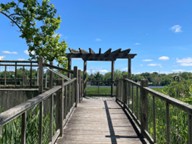
Tired of the same old gym routine and the threat of thunderstorms possibly turning a bike ride into a bad scenario, I resolved to go for a walk some place close to where my car would be parked just in case the weather decided to cooperate with the forecast. That’s when I thought about Boundary Creek Natural Resource Area, the park I ventured out to in a misty rain two days before Michael died. Despite all forewarning, I defied the weather predictions and chose to head out on another misty morning almost three years later. The trail itself was not very large and the parking lot was speedily accessible no matter which way I walked. There’s also a bathroom with a real toilet (albeit a steel one with no seat and freezing to the tush regardless of the time of year) and toilet tissue (most of the time and why I always carry tissues in case there’s not) – always an added benefit.
As I drove to the outskirts of Moorestown, New Jersey it dawned on me that I had never been to Boundary Creek in the summer, nor had I ever walked it, having only gone by bicycle on October 25th twice since 2015 in what had become a newer annual pilgrimage, one I have made every year since. Weather permitting, this time I was going to take my time and really look around, determined to read every single sign in true Arthur Doherty form (Sidebar: When my siblings and I were young and dad took us to a museum or historic site, he would make us go through every single exhibit in order to get his money’s worth, an inherited habit I’ve found difficult to break and that the hubby and the kid find painfully annoying).
Boundary Creek is located along Rancocas Creek, a waterway named after the Rankokous, a Native American Nation of the Powhatan Renape (not to be confused with the Ramapough Lenape). Starting off the Delaware River and running a little further south of Vincentown, New Jersey, Rancocas Creek winds through a number of major hubs in southern New Jersey. I discovered that the park was part of a 1,050 acre peach plantation originally owned by John and Grace Hollinshead, immigrants from England in the mid-17th century. At the time the southwestern counties of New Jersey were being settled there were no roads; hence the creation of a “riverline highway” for steamboat transportation (for goods, animals and humans alike) up and down the Rancocas. Conveniently, John Hollinshead also owned and operated one of those steamboats.
Three hundred years later, throughout the 1980s the Burlington County Board of Chosen Freeholders began acquiring land in order to preserve what are known as “Green Acres,” a program created by the State of New Jersey to develop more recreational parks and conserve millions of acres of undeveloped land. By the early 2000s, Burlington County boasted over 3,500 acres of open space (as of 2024 it was 5,662) and over 29,000 acres of protected farmland, the Hollinshead property being one such acquisition in 2002. By 2004, the county began planning and designing the preservation of the natural habitat that later acquired its current name.
The park has become home to hundreds of plant and animal species: milkweed wafting lilac scents, enticing the Monarch butterflies to stop on their migration north; stately purple and orange coneflowers swaying in the breeze, honey bees hovering to get their pollen; wild raspberries beginning to ripen and bright red berries taunting the local wildlife; captivating fungus growing haphazardly on fallen trees; sweet-smelling honeysuckle waiting for their nightly moth visitors; a multitude of waterbirds, birds of prey, songbirds, woodpeckers and herptiles (yes, that’s a thing) fluttering along the creek in search of tasty insect morsels; mammals hunting along the trails, hiding in the meadow and sneaking around the orchard, inviting you to hide out and spy or just merely sit and ponder. I took my time and really looked around, reading every single sign in true Arthur Doherty form. I also noticed more details I hadn’t the first three trips: the etchings of little turtles and birds on the observation platforms; the marlin houses built and donated by a local birder; the accuracy of the human sundial at the entrance of the park; the tiny little footprints of ducks, storks and racoons on the boardwalk. It looked about the same yet a little more overgrown than before. Time had passed, another year had come and gone.
Finishing up the one and a half miles of figure-eight trails and offshoot boardwalks, with the rain still holding, I thought it would be a good idea to go pick my own fruits and veggies, an activity with a very short window in any given year. You just can’t beat fresh organic produce grown locally and picked by your own hands. I decided to stop off at Johnson’s Corner Farm. Driving out of the parking lot, I officially declared Boundary Creek to be Michael’s Farm from that day on. I planned to forward a memo to the County Board of Chosen Freeholders ASAP (never happened). As my stomach began to growl, I stopped at a local convenience store to purchase some hard boiled eggs, promising myself some ice cream at the farm but only after eating something healthy like a nice homegrown peach. On the way, I somehow convinced myself to go to the gym after the farm, despite my decision that morning to skip the old boring gym routine. Besides, if I was going to eat ice cream, I had to hit the gym to burn off the calories, right?
Although I had lived in the area longer than my mother and father (they would only live here for three years and one year respectively before they both passed away), they managed to find Johnson’s with Kathy’s help. It was one of their favorite places to go. Finding its origins in 1953, after selling corn from their home in Medford, New Jersey, Bill and Betty Johnson opened their first roadside market in the mid-1960s: a wagon hauled to the corner of Church and Hartford Roads. Soon, the wagon turned into a shed, eventually growing into a building and the marketplace that exists today. You always know what season it is at Johnson’s: strawberry shaped lights dangling from tree branches; large ladybug flags hanging from the picket fence blowing in the wind; colorful baskets of flowers brilliantly presented in the nursery; the sound of children laughing and playing on the playground; whimsical seasonal tchotchkes for the home on display inside the store; planters made from old license plates for sale in the parking lot; and hay rides out to the fields to pick your own fruit and vegetables. Summertime had officially arrived.
When they were alive, my parents would check out the baked goods, mom inevitably complaining about the prices. I would remind her that it was homemade and freshly baked. You get what you pay for, ya know. She would see what produce was available, again complaining but this time about how they never seemed to have what she wanted. I would again remind her that it was a real farm. Stuff was actually grown and picked there depending on the season. Then she would head to the freezer, the one with the Roselli’s foods in it. Of course, Johnson’s never had what mom was looking for. Again with the grievances. As usual, I would suggest we drive next door and see what Roselli’s had in their own store. Thankfully, she would typically find something she liked, but not without a few quibbles first.
Roselli’s Italian Market was established in 1969 by Dolores and L.E. Roselli. Recently, the old shop (the Roselli’s former home) was closed and a new one opened on the same property. The new shop provides even more authentic pre-made Italian foods, baked goods, cheeses, snacks, sandwiches, pantry items and beverages. Mom would’ve been so excited, although I’m sure she would have complained about too much change and too many choices. Mom used to love shopping there as well. For a number of years after mom died I didn’t often go to Roselli’s. Aside from their spaghetti sauce that I can buy in any grocery store, there’s nothing kosher there. If it was kosher, however, I would have been buying everything off the shelves.
Since the first visit to Johnson’s with my parents, I have ridden my bike there numerous times, oftentimes as a pitstop on long rides through Burlington County. The hubby, the kid and I have gone there many times as well over the years. They have hayrides that take you to pick-your-own fields: strawberries, blueberries, snap peas and cherries in the spring; corn and peaches in summer; pumpkins, sweet potatoes and broccoli in fall; and Christmas events filling out the season before closing for winter. There’s a kids area with a barnyard, petting zoo and a playground with a pond, as well as various festivals throughout the year that provide ever-changing entertainment for people of all ages.
Burlington County is a beautiful place to ride your bike. It’s the part of New Jersey that people question, “That’s New Jersey?!” Yup, that’s New Jersey! Dubbed “the armpit of America,” New Jersey is known for its port terminals, multitudes of industrial parks and chemical plants, Newark Liberty International Airport, Atlantic City and, of course, Camden, one of the most dangerous cities in the United States, often being number one on the list. For the record, what you see when you get off the plane in Newark is not New Jersey. People don’t realize that New Jersey is loaded with colorful farms as far as the eye can see, chock full of cows, horses, ponies, donkeys, alpacas, sheep, goats and chickens, just to name a few. There’s also hundreds of open roads lined with acres of unsettled land dotted with an occasional house, local markets and mom and pop shops. We have 130 miles of coastline, including a number of boardwalks, highlights being Asbury Park, Seaside Heights, Ocean City, Wildwood and Cape May. I’ve ridden miles and miles and acre upon acre of open undeveloped space.
When I’m at Johnson’s is when I miss my mom the most and can’t help but think of her: “What would she like and what would she complain about this time?” As I looked around, I still caught myself going for my cell phone and wanted to call to let her know what they had: “Dammit, you would love the produce today! They had broccoli! And you should see the pies!’ Then came the hesitation. I no longer had her phone number in my list of contacts, nor could I remember it if I could call. Her old house is just up the street from Johnson’s, but now it has new inhabitants much younger than her and my father. However, I knew she was there looking with me.
Arriving at the farm on that misty summer afternoon, I entered the shop to purchase some produce not available for picking, particularly the peaches (quite possibly Boundary Creek’s influence). I quickly scarfed down a peach to satisfy my insistence on eating something healthy before going for ice cream. As soon as I saw the list of flavors, I knew what I needed: blueberry pomegranate chocolate chip! Sauntering inside to buy tickets for the hayride that would take me to the fields where I had predetermined picking my own blueberries, strawberries, snap peas and green beans, I was informed by the cashier that the tractor driving away as we spoke was the last one until the next day. I just had to stop for that ice cream, didn’t I?! Argh! Fuck the gym! In the end, I just stopped off at a local supermarket and went home to cook dinner.
A box of hot cereal started that day’s journey. How funny that a simple red cardboard box filled with farina can expel a swarm of reminiscence of our family home in Ramsey filled with 15 years of childhood memories, mom ever-present for whatever was needed. Still seething over my inability to pick my own produce and not burning off those ice cream calories, unlike my defiance of the “definite” impending thunderstorms that never happened, I succumbed to the almighty’s advice: sometimes you need to not have a plan and just go with what has been given to you: another day of life. And then a friend came over that evening to give me some freshly picked strawberries in exchange for some old Passover dishes I had given her earlier in the week. Indeed, someone was up there looking down on me.
Thanks to my discovery of Boundary Creek on that misty October morning in 2015, I have found many new routes throughout Burlington County to take Old Bessie. One of the main drags for cyclists in Burlington County is Church Road (not to be confused with Church Street; they are two very different roadways), beginning in Merchantville and ending in Vincentown, New Jersey. I often ask myself if roads are named for what’s on them: Does Mansion Boulevard actually have a mansion on it? Someday I’ll actually drive down it to look and see. Did a king live on Kings Highway at some point? There certainly aren’t any castles. Are there a lot of beavers on Beaver Avenue? I’ve never seen one in New Jersey after a lifetime of living here for nearly 60 years. I’m still wondering if there’s any knollwood on Knollwood Drive. What is a knollwood anyway?! Knoll is a thing and wood is a thing, but I’m convinced that Knollwood is a completely made up word, yet there are dozens and dozens of streets, neighborhoods and cities named Knollwood throughout America. Needless to say, there’s a number of churches along Church Road. For example, Church Road in Cherry Hill was named for St. Mary’s Church, one of the first Episcopal churches in west Jersey, although it no longer exists after burning down hundreds of years ago. Riding the entire length of Church Road, there are also a lot of farms, expansive areas of emerald green land with brightly saturated red barns and fields of locally grown produce such as asparagus, bell peppers, blueberries (which Jersey is famous for), cabbage, cranberries (also famous in Jersey), eggplant, endive, lettuce, snap peas, soy beans, spinach, tomatoes (also famous for) and field upon field of corn (again, famous). In my opinion, it is one of the most beautiful areas in New Jersey.
One particular day in May 2017, after my usual stop at Johnson’s and continuing down Church Road through Medford, I came across an old, abandoned hip-roof framed house next to what appeared to be an old gravel parking lot. Deciding to stop and check it out, I discovered that it was a historic site. The now vacant property was the former office of “Dr.” James Still, the older brother of William Still, the Philadelphia abolitionist and one of the founding fathers of the Underground RailRoad. Known as “The Black Doctor of the Pines,” James was a free slave who learned medicine and herbalism without having ever attended medical school, eventually becoming one of the wealthiest men in Burlington County. Fifty years after his death, the house was demolished by its subsequent owners in 1932, but the office remained behind. The property was later purchased by the Bunning family who raised cows and chickens but later sold the land to the State of New Jersey, including the farmhouse, a barn, stables, corn crib and other miscellaneous buildings. It would be the first African American historic site purchased by the state, the farmhouse being turned into the Dr. James Still Office and Educational Center. That first time there, I started to wander around a bit. It didn’t appear to be open, but I walked up the driveway to take a peek at several of the structures behind the house. I didn’t venture too far out though, not knowing if it was typically open to the public (it wasn’t). However, if I didn’t stop at Johnson’s first, the Still site became a regular stop along my treks down Church Road. At some point over the last couple of years, I finally found a website for the park. It now has a Visitor’s Center that opened around the corner in 2021 and hosts an exhibit on James’ and William’s lives. There is also a new nature trail (thanks to the local Eagle Scouts) beginning at the back of the center through a wooded area to a mowed grassy loop around a field of vibrantly colorful wildflowers, shrubs and trees that used to be the Bunning farm.
Another mile down the road, I stopped at a place I had driven by many times but never explored, an historic site known as Kirby’s Mill and Museum, which also houses the Medford Historical Society. Built on Rancocas Creek in 1778 by Isaac Haines and the last working gristmill (for grinding wheat flour, buckwheat, rye flour, cornmeal and chicken feed) and sawmill (for cutting lumber) in New Jersey, the mill is one of the oldest in southern New Jersey, where grain for the Continental Army was processed and became a center of commerce for the local communities. In 1785, Isaac’s younger brother, Nehemiah, built the brick-faced Miller’s House (a.k.a. The Nehemiah Haines House) catty-corner to the mill for his son Charles. Charles later expanded the mill and built a blacksmith shop and a small barn directly across the street from the mill, along with a wheelwright shop and cider mill. Behind the mill is a one-story three bays wide frame house with a shed roofed porch believed to have been the residence of the sawmill foreman and is now referred to as the Sawyer’s House (clever). The mill was later purchased by William Kirby; hence its current name after being sold to the Medford Historical Society in 1969. Since then, the mill and its environs have been slowly renovated to their former glory with seasonal events and activities throughout the year and demonstrations of the mill’s waterwheel, as well as an extensive collection of antiques and a museum that includes a country store, miller’s shop, print shop and carpenter shop. The blacksmith shop and sawmill have also been restored. Eventually, the storage barn will become a farming museum, the Sawyer’s House a historic library and research center and the carriage barn will store a collection of historic wagons.
Six months later, I would discover the Flying W Airport after noticing a sign on the corner of the Kirby property, dark green with a white horizontal silhouette of an airplane and the words FLYING W RESTAURANT AND MOTEL, an arrow pointing down a road I had never traveled before: Fostertown Road. A mile and a half up the road, I came upon the airport. It was built in the 1960s by Bill Whitesell, his initial objective to provide air transportation services to those involved in building the Alaska PipeLine. The airport now mostly accommodates local crop dusters, people wanting to learn to fly or residents who store and fly their own planes, as well as giving tourists access in and out of New Jersey via private planes. Aside from the landing strip, locals often dined in the restaurant that doubled as a bar and cafe while their children played on the multitude of kiddie rides scattered around the porch. Travelers could stay in the quaint Flying W Motel, while tenants and residents of Medford had access to the famous airplane-shaped swimming pool with a single-engine cessna tail poking out of the recreation shed. Wishing I knew about this place while Michael was still alive, I know he really would’ve gotten a kick out of it.
Back to that bike ride in May of 2017, I decided to continue down Church Road, where it ended in a quaint little town called Vincentown. Founded by Vincent Leeds (Leeds is a common name in southern New Jersey and the renowned family of the Jersey Devil) in 1743, “Vincent’s Town” was designed around the Rancocas Creek flowing through the village. Some of the original buildings still remain, including the Old Town Hall built in 1884 that is currently used as a meeting place for the Southampton History Society and has a small museum located within the building. Outside, in the rear of the hall, is the “Lock Up,” a 15 by 14 foot addition with two five by eight foot cells, a small waiting area and a four by eight foot office area built in 1891 that now houses a law enforcement museum. There is also the town’s first one-room schoolhouse from 1860 restored to its original state. The Vincentown-Tabernacle (both villages originally known as Northampton Township) Telephone Building, the original independent telephone company established in 1908 and taken over by New Jersey Bell in 1930, now houses the Southampton Historical Society where the company’s equipment and records have been preserved and made into a museum.
Heading towards home, I pedaled my way towards “civilization.” After a day of open roads and some of the most beautiful countryside, friendly faces and peaceful quiet, I felt instantly frantic in the wake of speeding cars and honking horns. Talk about a buzz kill (at least it’s not Newark). At one point on my way back through Lumberton, I realized I had been down those roads a couple of times in previous years. Way before Ole Bessie, I had to drive my Schwinn to a nearby parking lot to ride only a smidgen of the route. The first time I painfully struggled to finish the loop and got lost for hours (pre-cell phone era and way before mapping apps and devices). I returned a second time a few years later, refusing to give in to pain and disorientation. I did better, but the ride still ended in discomfort and occasional wrong turns. However, on this trek, I suddenly knew where I was and where I was going, despite Ole Bessie never having been there (okay, having a smartphone with a reliable map app does make it easier). I felt energized by the fact that I had ridden my bike the whole way there from home that time. I also realized something really important: through practice, perseverance and patience I had a confidence so encompassing I almost cried. I was so self-assured of my riding abilities and fearlessness that I actually got to see where I was going because Ole Bessie and I had become one.
One of my other main routes through Burlington County is a road called Elbo Lane. Before my parents moved to the 55 and over community located off Elbo Lane, this road was not even in my sphere of cycling knowledge (or any knowledge, for that matter). Yes, I realize that “Elbo” is misspelled. There’s also a town in Cape May County known as “Dias Creek” that was originally named “Dyer’s Creek” for the farmer whose land butted the waterline. Okay, I acknowledge that New Jerseyians are not the best at spelling or pronunciation, but we’re a quaint species nonetheless. What I find comical is that in its four and a quarter mile length there is actually an “elbow” on Elbo Lane, either at the beginning or at the end, depending on which way you’re heading. I’m for once content that a road actually lives up to its name, despite its inability to spell correctly. However, I rarely ride that elbow, mostly because of the sharp bend in the road and the dangers of not being seen by motorists plowing through and crossing the double yellow line. I prefer to sneak down Texas Avenue (I wonder if there are any Texans on Texas Avenue?). On one particular day, I decided that I wasn’t going to time myself or look at the odometer. I was going to enjoy the beautiful day and just ride for as long as I felt like. If I found something interesting to investigate or wanted to take a picture, I was going to stop.
Turning right off Texas Avenue and heading down Elbo Lane, something caught my eye at the Mount Laurel Fire Department, prompting me to turn around after passing by. It was a large piece of twisted metal rising toward the heavens against my beautiful blue sky. I had ridden by that facility dozens of times and never noticed the 9/11 Memorial on display in front of the building and questioned my awareness. After learning that the memorial had just been erected the month prior on the 16th anniversary of 9/11 (thanks to the invention of the smartphone and a multitude of search engines), I was reassured of my knack for acuity. Not knowing from which tower it fell, a 17-foot high steel I-beam was recovered at Ground Zero and donated to the fire department to be put on display. Other artifacts of this September 11, 2001 Never Forget Memorial include a piece of limestone taken from the Pentagon and a large rock from the crash site of Flight 93 in Pennsylvania. It reminded me of that day and how much I really don’t like to think about it.
September 11, 2001 was the kid’s “half birthday:” she was exactly two and a half years old. The kid was busying herself with play (i.e. doing everything in her power to interfere) while I exercised along to a video on the television in the living room of our 1000 square foot rancher. A few minutes after 8:46 AM, the phone rang. Continuing to work out, I listened to the answering machine (post Gen Xers can look that one up online) as it recorded my mom’s voice on the other end. Panic was in her voice as she demanded I respond to her call. Picking up the receiver, I asked her what was wrong. “Turn on the t.v.! We’re under attack!” As ordered, I turned the channel to one of the cable news stations and watched as the North Tower burned. Now it was my turn to panic. The kid could tell that something serious was going on as I desperately attempted to calm my mom down. Trying to figure out what had happened, I watched as a jetliner crashed into the South Tower at 9:03 AM…then the Pentagon at 9:37 AM…and finally, a crash in rural Pennsylvania at 10:07 AM. Most of that day was an emotional roller coaster of hysteria and complete terror as the skies grew quiet, very quiet, for the next 48 hours. For weeks I was glued to the news, paralyzed by the incomprehensibility of events on that mild Tuesday morning with my beautiful blue sky, its youngest victim being exactly two-and-a-half-years-old. It took years before I didn’t cower when planes flew overhead, and the kid became so frightened by my reaction she refused to leave my side for over two years. At some point, however, I finally turned off the news and never watched it again.
In the week following 9/11, on a quiet Saturday morning with my beautiful blue sky, a friend decided to go ahead with the wedding she had planned over the previous year. This particular friend spent decades dating all the wrong guys until her late thirties, when she happened to meet up with an old acquaintance from elementary school (this actually happened to another friend of ours). In a storybook fairytale, they fell in love and got engaged two years later during a romantic getaway somewhere along the Florida Keys (naked, I’m sure, because all their outdoor interludes seemed to be naked on a beach somewhere on the east coast). Originally planning to exchange vows on the beach, the ceremony was transferred to a little church on the main drag due to public restrictions being enforced throughout the mid-atlantic region (something we would experience once again 19 years later thanks to COVID 19). Wearing her fantasy wedding gown purchased online months before and meticulously altered to fit her body like a second skin, she and her husband exchanged vows to a tearful congregation. I had known this woman for 10 years and watched her struggle from one relationship to the next. I was truly happy for her but couldn’t stop thinking about the collective sorrow resonating silently throughout the chapel. For a year we helped plan the perfect wedding, never anticipating something as horrific as 9/11 changing her plans. As we gathered together to leave the church and head to the reception at a restaurant on the bay with a display of the beautiful wedding cake she designed to look like a sand castle (and it did), we thanked our friend for providing a moment of peace and love desperately needed after a long week of tremendous despair.
Continuing down Elbo Lane, I decided to stop at a church I’ve passed by dozens of times in the Hainesport section of Mount Laurel (once known as Colemantown, named after John Coleman, an early black settler of Burlington County who was a pioneer in the Underground Railroad). Since I normally take my long rides on Sunday, there’s always a full parking lot and that day was no different. As I approached, I slowed down to read the sign in front. Built in 1847, the “newer” Jacob’s Chapel AME Church was built to accommodate its growing membership and is known for playing its part in the Underground Railroad. To the left of the church is the oldest standing Black schoolhouse and religious meetinghouse (the original chapel built in 1840) in the State of New Jersey. At first glance, I didn’t notice the large cemetery down a grassy path behind the church. On inspection, I wandered through the dozens of pre-Civil War graves of escaped and freed slaves, as well as the graves of Black soldiers from New Jersey who fought in the Civil War. I also discovered that James Still is also buried there.
For three glorious hours, all I saw was Michael’s beautiful blue sky, the best drug on the planet. But despite my seemingly cognizant attempt to stay away from it, I missed my turn and ended up on the end of Creek Road where the entrance to and exit from Interstate 295 takes over and cyclists are told to, “Get the fuck off the road!” at regular intervals, even though we’re legally permitted to be there, albeit a crazy thing to do. Managing to not get hit, run over and/or killed, I survived long enough to end up back on the scenic side roads of Burlington County…and then Michael’s sky grew thick and gray. It was time to head home.
********
Wintertime is the most difficult time for Ole Bessie, but thanks to global warming we get an occasional ride in here and there. Although I was much more audacious in my younger days, cruising through hot, cold, rain, wind and snow, I’ve grown to dislike cycling when the temperature goes above 90 or below 50 degrees, let alone during any form of precipitation or a breeze that leaves me breathless. God forbid the temperature rises above 50 degrees! I can hear Ole Bessie whispering from the garage, “It’s over 50 degrees outside. Why are we still inside?!” And it was on one of those climate change days on a chilly day in Mid-January 2017 (it was 67 degrees) that I discovered something new. Two and a half miles further up the road from Jacob’s Chapel, Elbo Lane turns into Stacy Haines Road in Hainesport, named after Richard and Margaret Haines who first settled the area. You’ll be thrilled to know that, yes, there are people with the surname Haines still living on this road, but I’m not sure about Stacy though. It is also home to the Air Victory Museum.
My first rule of thumb when riding my bike? Know where all the bathrooms are. The Air Victory Museum just so happened to have a Mr. Bob. Why name a latrine Mr. Bob? I guess it sounds better than Mr. Piss ‘n Shit. Standing next to Mr. Bob is a Northrop Grumman E-2 Hawkeye, an all-weather, carrier capable tactical airborne early warning aircraft the likes of the Starship Enterprise. What would Michael make of this monstrosity? I wish he was here so I could pick his brain. Only a true Star Trek fan could appreciate it. Most days whenever I’ve gone there, I get my beautiful blue sky. Michael would have loved this place. And because of its location, surrounded by parks, wildlife refuges and farms, there are barely any cars on the road, a cyclist’s dream.
Although I’ve stopped at the grounds a number of times, I have never actually explored the museum itself because it never seems to be open, despite their website claiming otherwise. Being that the museum is also a plane hangar on the grounds of the South Jersey Regional Airport, on any given day you can watch as pilots navigate their aircrafts around the tarmac of the small airport as they takeoff, land and fly around the neighborhood. In cocktail phenomenon fashion, I like to listen to the local folks sitting on the airport cafe porch talking about planes, flying, the specials of the day or simply nothing at all. There is one particularly opinionated gentleman who seems to have the answer to everything and anything anyone should need to know in life, whether they want to know it or not. Looking at the small single-engine planes at that airport, I can’t help but recall how some of the 9/11 hijackers took flying lessons at little airports throughout New Jersey like this one in order to gain the knowledge they would later use to kill thousands of people. Sorry, I tend to be a Debbie Downer sometimes.
While riding in the sticks of Lumberton on the same day that I discovered the 9/11 memorial in Mount Laurel, I came across a pile of horse manure free of charge on the side of the road. Yup, some days when everything is right in the universe with the sun high in that beautiful blue sky and you’re just coasting through life feeling groovy without a care in the world, a huge pile of shit is going to find you at absolutely no cost whatsoever. So why the challenge? I believe that we are given what we can handle and maybe sometimes we need a little humility to remind us of our fortune in life. But how does one explain pure evil? Why do we need the challenge of men full of hatred turning jetliners into weapons of mass destruction and killing thousands of innocent people? Perhaps we need an occasional reminder as to why we all need to be better human beings. Sorry to harp. It was a very impactful day for America, especially for those of us living in New York and New Jersey at the time.
In August of 2017, on a bike ride to Smithville (Burlington County, not to be confused with Atlantic County; they are two very different Smithvilles, one of which we have lived in), the old saying of time heals all wounds came to mind for several reasons. The first stemmed from a number of properties along my various routes that were once controlled by humans but have since been abandoned. After many years of injury and insult, I discovered that our planet had somehow managed to lick and heal its own wounds.
About three or four years prior, there was a property on Elbo Lane on the corner of Texas Avenue that was occupied by a prefab ranch-style house, a manicured lawn and several human beings, but a raging fire burned the house down to the ground and the owners were forced to leave the property behind. Over the years, I watched as it was sold several times from one human to the next with the house ultimately razed and the lawn growing wild. In a matter of two years, this “property” was back to its natural state (except for the occasional mow by whatever current “owner” it had). It’s moments like that when I truly believe our beloved planet Earth will repair itself long after we’re gone. And cycling is the only way I would have noticed.
My second stop was a local convenience store where I met a man and his wife from Bucks County Pennsylvania biking the local trails. As we talked, the husband asked me about riding alone, so I justified my preference to travel solo: I go at my own pace, stop wherever and whenever I like, don’t have to hold conversations or entertain guests and can be spontaneous depending on how I feel. At first the husband was agreeable, but quickly turned to the potential dangers of my lone adventures (so not cool, dude). The first thing I thought of was Terri Jentz, the author of Strange Piece of Paradise. Terri and her Yale roommate decided to bicycle cross-country in the summer of 1977, having no experience to take on such a tremendous expedition. While camping in Oregon, a man in a pickup truck ran the two women over and then attacked them with an ax. Although they both eventually “recovered,” the permanent physical, mental and emotional damage is unimaginable. Their assailant was ultimately found but never charged for the crime. Sure, Michael and his friend rode over 60 miles on a whim as teenagers, but that was just over the border and done in a day, and both boys had experience riding bicycles long distance. I’ve been riding seriously for over 20 years and have only crossed New Jersey (the shortest distance, west to east), all five boroughs of New York City (a tiny percentage of the state) and parts of Philadelphia, its suburbs and the Poconos in Pennsylvania. Although it’s a long-time fantasy, I would only bike the entire United States in a group. It’s the one time I would never ride alone.
I also thought of Christopher McCandless, the young man who was the subject of Into the Wild. I read the book after seeing the movie. The funny thing is that after reading the book and every time I watch the movie, I’m pissed off that he traveled alone and had no experience whatsoever to take on his endeavor. Every time I ask, “What the fuck was he thinking?!” And then I think about my own lone cycling: “What the fuck am I thinking?! ” Rationale says, “Oh, you know where you are and have the experience to know what you’re doing,” which is true. I’ve also had those lone moments as a young adult: moved to Arizona at age 18 with no prospects except Michael’s apartment, met and lived with a drug addict who drained my bank account, forcing me to live off my co-workers and friends until returning to New Jersey to live with another addicted person before begging mom and dad to take me back. Agreeing to take me back (only if I got my shit together), I ultimately attended Stockton State College (now Stockton University) at 20 and University College, Galway at age 22 not knowing a single soul in either place.
After the husband asked me where I was heading next (and ignoring fatherly advice), I told my new found convenience store friends that I was thinking of heading to Smithville, where I would ultimately be met by another bridge out of order – flashback to September 16, 2015, My Gump Ride beginning. There’s way too many bridges in need of attention in Burlington County. Although the road may have been closed, on a bicycle one can ride the trails and reach the intended destination anyway (wink, wink).
Originally a Native American settlement along Rancocas Creek, the land had a number of owners until Hezekiah B. Smith, an inventor and industrialist from Massachusetts purchased it in 1865, naming the property Smithville. Smith built shops for the expansion of his woodworking machine company and housing for hundreds of workers in his employ, as well as his infamous Smithville-Mt. Holly Bicycle Railroad (created to allow workers from Mount Holly to travel to Smithville for work via bicycle – seriously cool, right?!) and the Star high-wheeled bicycle (ya know, the one with the humongous wheel in front and tiny wheel in back?). His descendants resided in the mansion until the early 1960s, the property and mansion being purchased by Burlington County in 1975. This once vibrant community had been abandoned for decades, the earth repairing itself once again, Smithville Lake providing fishing and boating. However, over time, a multitude of trails, boardwalks, gardens, a playground and several picnic areas were developed to embrace its charm and beauty. Tours are also given of the mansion with one outer building hosting the Visitors Center and others displaying exhibits with the occasional docent in costume on hand to tell of Smithville’s vast history.
After several hours of hugging the planet and feeling groovy about my carbon footprint, I realized that this was one of those days when I forgot about the trip home; that’s when the “Little Voice” takes over to tell me how foolish I am, my body deciding to listen to the Little Voice and shut down. Muscles seizing, hands and feet throbbing, head spinning and lungs refusing to function and thinking I wouldn’t survive, I pedaled through quicksand to make it home in time for dinner. As usual, I wouldn’t remember the day and probably head out in a couple of days to do exactly the same thing all over again (I did four days later).
A little over two weeks after that ride to Smithville, the kid would travel alone to Israel for a 10-month long college program (what’s known in Jewish circles as a “gap year” between high school and college). She had been there four times previously without me or the hubby, albeit not as long. Contemplating my life at age 18, I wasn’t worried (or so my anxiety told me). Her plans changed daily at that point. I understood why, but by her age I had graduated from high school, was working full time, living on my own and facing life’s difficulties head on, paying rent and bills, getting ripped off and living with addiction. And while I was living that life, in a far away land the hubby was in the army facing very different circumstances. I needed to believe she would be okay. I knew she would figure it out. We all did, which reminded me of the purpose of my blog at the time. As I rode Ole Bessie, taking photos of my exploits on my crappy outdated smartphone with the cracked screen and blogging about my travels, I found that time (and my writing) had helped to heal my wounds.
********
Mother’s Day; that’s an easy one for my brood: a long bike ride, barbecued steak or a big fat bowl of pasta and a bottle of red wine waiting for me at the end is all I need (and don’t dare make me clean up after y’all). For 18 years, Mother’s Day was all about this mother being left alone to do whatever she wanted and not having to play mommy for the day. So, Mother’s Day in my book is actually “Me Day.” Mother’s Day 2017, after following the weather over the previous days, as usual, we had a 20% chance of rain. Why does it feel like that 20% chance is literally always hanging over my head? Flying by Lockheed Martin’s warship, the USS Rancocas, among the waving corn stalks (a.k.a. the Cruiser in the Cornfield), I rode quickly out of the storm clouds and decided to visit my Therapy Bridge because that morning an online map assured me it was open, a satellite photo showing a newly paved road with a number of cars flying over the creek. Obviously the local cartographers with their car cameras had not been there in recent years. Obviously I’m an idiot for thinking differently. Sometimes my optimism scares me.
As I turned Ole Bessie around, the rain fortunately decided to head in the opposite direction and the sun decided to follow me for the rest of the trip. I followed Rancocas Creek up Creek Road (the name makes sense, being that it runs parallel to Rancocas Creek), making a pitstop at Boundary Creek and rode to the end of the road where the creek merges with the Delaware River. Unfortunately, no matter which way you go, you’re gonna hit the dreaded Route 130 but somehow I managed to cross over the highway to hell and continued on until reaching River Road running the length of the Delaware River, another road that fellow cyclists seem to enjoy yet produces significant anxiety for me deep within my soul. With the fear of imminent death, I pedaled as quickly as possible until the “bike lane” allowed enough room for me to catch my breath. A turtle crossing sign made up of recycled roof shingles caught my eye.
Little Voice: “Okay, if the turtles don’t have a chance in hell, what of us?!”
Me: We humans and bicycles don’t even get a sign. Does that answer your question?
There is a small borough along the river known as Riverton (makes sense again, being that it’s on the Delaware River), a quaint little main street kinda town. This is where the River Line train connects Camden and Trenton, New Jersey. Noting a giant eagle sculpture in front of the local pharmacy, I discovered it was one of 11 eagles (no, not from the football team, although some do live in Moorestown) created from an art project called “The Eagles Have Landed” and placed at each of the River Line stations from Bordentown to Riverton as a means of promoting economic growth and tourism (I don’t think it really worked).
Safely making it into Riverton, I checked out the local shops on the main drag. One promoted painting lessons while others offered paint-your-own pictures or make and paint your own pottery. There was a dining-with-yoga place (what even is that?!), an old-time hardware store and the obligatory tattoo and piercing shops, along with the typical main street liquor and convenience stores. As I came to a red traffic light at the intersection of River Road and Main Street where I normally turn left, I decided to check my map app to see what would happen if I turned right. I stopped briefly at a beautiful 19th-century church with a stately red door where I met a little boy walking his bulldog named Ruby. The boy’s father then appeared on his bike after a nice morning ride and the three of us chatted for a few minutes…until someone slammed the church door shut, loudly. We got the hint and moved along.
Main Street ends at Bank Avenue, home to the Riverton Yacht Club. Established in 1865. It is the oldest yacht club on the Delaware River, the oldest one in New Jersey and one of the oldest steamboat landings in the country (on the same route as the one from Boundary Creek). A mere seven short blocks long, Bank Avenue is lined with gorgeous 19th-century mansions, once the summer homes of some of the most prominent (mostly Quaker) families of Philadelphia. Across the street from the yacht club is the 1851 Riverbank Manor, or the Caleb Clothier House. Caleb was vehemently opposed to slavery and offered his home as a stop on the Underground Railroad. I also noticed it was up for sale. If you have to ask the price, you can’t afford it.
Coming to the end of Bank Avenue, I turned left toward River Road in order to get back onto Main Street and head home. This time I decided to stop at an old abandoned Victorian house on Riverton Road I had ridden by a number of times, the vegetation heavily overgrown and taking over its structure. Awkwardly attached to the farmhouse was a long one-story brick building resembling a school. A sign in the front yard said it was the Cinnaminson (Native American for “sweet water”) Summer Home established in 1880. The only information I have found about it was that the Westfield Friends had opened a 10-week summer program in 1897 for up to 300 underprivileged children and their mothers from Philadelphia, giving them a break from the sweltering city heat, stifling pollution and rampant disease. It was part of a nationwide effort called the Fresh Air Movement that existed at the turn of the 19th century and into the early 20th until 1920 when the program was shut down. There, the children had the opportunity to experience the outdoors while receiving religious and moral instruction. (The home lay in ruins for 100 years until the property was purchased by a real estate developer in 2019. The entire structure was razed and low-income senior housing built on the land. History had been erased once again. The earth didn’t even get the chance to repair itself.)
Altogether, I rode 33 miles that day and felt a little more optimistic about that upcoming 54-mile long cancer bike tour three weeks later, the first of a number of rides I would endeavor in support of my brother Michael. A big fat steak and a bottle of red wine waiting for me tableside sure didn’t hurt either.
“When Bee appears in your life, the most common message it carries has to do with your levels of productivity. In some cases we are doing too much, and in others, not enough. Bee spirit has a strong work ethic, but it also knows the importance of stopping and smelling the flowers. There is a time to enjoy life’s nectar and a time to grab after the proverbial brass ring with vehemence. Bee helps with both and in finding the delicate balance between the two.”
-WhatIsMyAnimal Spirit.com
When I went on that long ride on October 25, 2015 to contemplate whether or not I should fly to Milwaukee, one of the things I thought about was what Michael’s animal spirit or totem would be, something I strangely contemplated with each human passing. On the way home, stopping at the red light of an intersection of billion dollar roads leading nowhere except to other congested places like those they left behind, I happened to look down at the ground and noticed a swarm of bumblebees hovering among the weeds surrounding my right foot. They simply went about their business and ignored the human invading their pollination feast. I didn’t think much about it that day or in the days following, until I got home from Milwaukee. For days after my return, dozens of bumblebees swarming around my garden would dance around my head each time I walked by, whisper buzzing in my ear, “Stop and smell the roses with us!” Then the spark ignited: bumblebee! My Gump Ride had been just that; it was my stop and smell the roses moment and Michael was there to tell me to keep riding.
 My Gump Ride
Leave a comment